India’s Food Safety Crackdown: Why Compliance Now Goes Far Beyond Adulteration
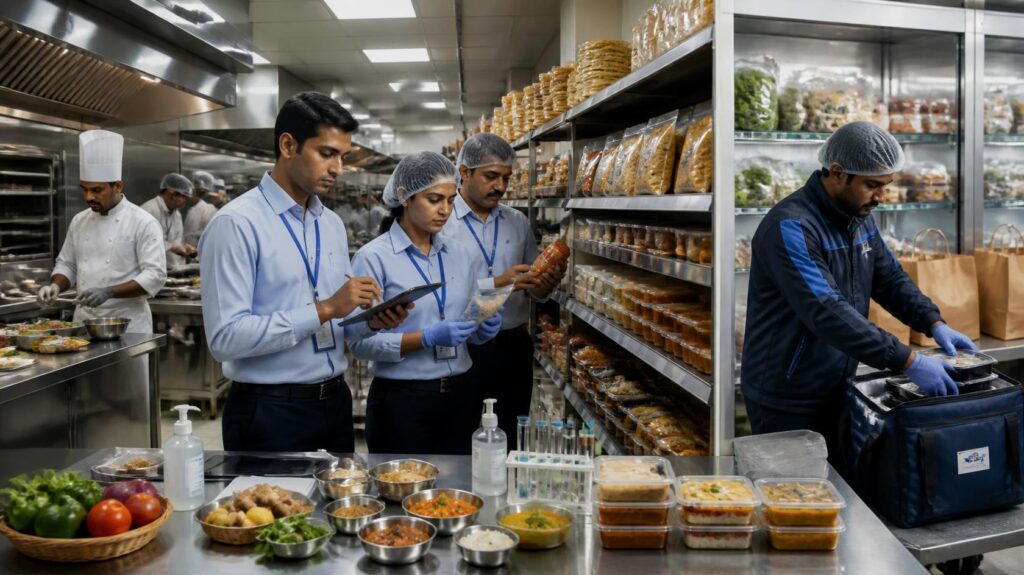
Food-safety enforcement in India has begun to look markedly different over the past few months. Five-star hotels, restaurant chains, quick-commerce dark stores, food manufacturers, nutraceutical companies and even celebrity endorsers have come under regulatory scrutiny. In many of these cases, the issue is not traditional adulteration or even an allegation that the food itself is unsafe. Regulators are increasingly examining the wider compliance environment in which food is manufactured, stored, sold and promoted, including hygiene, storage, labelling, product claims, digital listings, advertising and endorsements.
This activity comes against the backdrop of the Food Safety and Standards (Licensing and Registration of Food Businesses) Amendment Regulations, 2026, implemented on 11 March 2026. Among other changes, the Amendment introduced perpetual validity for registrations and licences of food business operators (‘FBOs’) and a technology-enabled, dynamic risk-based inspection framework. These reforms do not, by themselves, explain each subsequent enforcement action, but they form part of a wider move towards a more risk-based and technology-enabled supervisory model.
It is also important to distinguish between action by FSSAI and action by State Food Safety Authorities. While several recent labelling, claims and product-specific matters have involved FSSAI centrally, much of the enforcement concerning hotels, restaurants, clubs and quick-commerce facilities has been undertaken by State authorities. The broader trend is therefore not confined to a single regulator or jurisdiction.
What the Law Is Actually Enforcing
The recent actions make more sense when read against the structure of the Food Safety and Standards Act, 2006 (‘FSS Act’) itself. Section 26(1) places a continuing obligation on every Food Business Operator (‘FBO’) to ensure compliance with the Act and regulations at every stage of production, processing, import, distribution and sale within the business under its control. Section 27 then allocates liability down the chain: manufacturers and packers for non-compliant food; wholesalers and distributors for, among other things, supplying food after expiry or storing or handling it contrary to safety requirements; and sellers for food sold after expiry, kept in unhygienic conditions or misbranded. For hotels, restaurants, warehouses and dark stores, food-safety compliance is therefore not exhausted by checking the manufacturer’s label or licence.
The Act also gives regulators a graduated enforcement toolkit. Sections 31 and 32 deal with licensing and improvement notices. Failure to comply with an improvement notice can lead to suspension and ultimately cancellation of a licence, while Section 32 also permits immediate suspension in the interest of public health for reasons recorded in writing. Sections 38 and 47 govern inspection, seizure, destruction of certain deteriorated perishable food, sampling and analysis, while Section 28 addresses recall. These procedural provisions matter as much as the underlying offence when a business is responding to an inspection or notice.
The substantive contraventions are likewise distinct. Section 51 concerns sub-standard food; Section 52 misbranded food; Section 53 misleading advertisements; Section 56 unhygienic or unsanitary manufacture or processing; Section 57 possession of adulterants; and Section 59 unsafe food. Section 53 can attract a penalty of up to Rs 10 lakh, while Section 59 can involve imprisonment depending on the consequence of the unsafe food. These categories should not be collapsed into one another merely because an enforcement action begins with an inspection, raid or seizure.
For corporate compliance teams, Section 66 is particularly important. Liability can extend beyond the company to persons in charge and, where a company has multiple establishments, branches or units, to the concerned head or person nominated as responsible for food safety. The section also recognises statutory defences including lack of knowledge and due diligence. Documented controls, facility-level accountability and evidence of compliance are therefore central to managing food-law risk.
Selected Recent Enforcement Actions: Potential Legal Provisions Engaged
The provisions below are indicative, based on publicly reported allegations, regulatory statements or laboratory findings. They identify provisions that may be engaged; they do not imply that a violation has been finally established.
| Illustrative action | Authority / jurisdiction | Reported issue | Potential provisions / regulations engaged |
| Bengaluru three- and five-star hotel inspections (Aug 2026) | Karnataka Food Safety & Drug Administration | Expired food, fungal vegetables, hygiene/storage and segregation concerns; samples collected | FSS Act ss. 26, 27(3), 31-32, 38 and potentially 56; Schedule 4 of Licensing & Registration Regulations. Section 59 only if evidence establishes unsafe food. |
| Domino’s / Pizza Hut licence suspensions (Maharashtra) | Maharashtra FDA | Pest-control, grease/residue and expiry/labelling concerns | FSS Act ss. 26, 31-32, 38 and potentially 56; Schedule 4. Sections 23/52 may arise where labelling or misbranding is established. |
| Blinkit, Zepto and Swiggy Instamart dark-store / warehouse action | Maharashtra FDA | Pest infestation, expired stock, poor storage and cross-contamination risks | FSS Act s. 26; s. 27(2)(a), (b) and (e); ss. 31-32 and 38; Schedule 4. Sections 23/52 where labelling or misbranding is involved. |
| Zepto warehouse, Hoskote | Karnataka Food Safety & Drug Administration | Alleged misbranding, non-compliant labelling and hygiene/storage deficiencies | FSS Act ss. 23, 26, 27, 31-32, 38 and 52; Labelling & Display Regulations, 2020; Schedule 4. |
| Eat Fit Digestive Biscuits – ‘100% Atta’, ‘No Added Sugar’, ‘Digestive’ claims | FSSAI | Allegedly misleading composition / health-related claims | FSS Act ss. 23, 24, 52 and 53; Advertising & Claims Regulations, 2018; Labelling & Display Regulations, 2020. |
| Dabur – ‘100% Natural/Pure/Organic/Purity Guaranteed’ claims | FSSAI | Allegedly misleading claims and organic endorsement issues; prohibition order later stayed by Delhi High Court | FSS Act ss. 23, 24, 52 and 53; Advertising & Claims Regulations, 2018; Labelling & Display Regulations, 2020; Organic Foods Regulations, where applicable. |
| FOLINEURO Syrup | FSSAI | Product name and brain imagery alleged to convey neurological-health benefit | FSS Act ss. 22, 23, 24, 52 and 53; applicable health supplement/nutraceutical regulations; Advertising & Claims Regulations, 2018. |
| Vimal Elaichi celebrity endorsement notices | Maharashtra FDA | Alleged indirect/surrogate promotion of prohibited pan masala | FSS Act s. 24; potentially s. 53 if a misleading food advertisement is established; state prohibition powers/order under s. 30(2)(a) form part of the background. |
| Select whisky / rum actions over flavouring and age claims | FSSAI | Alleged sub-standard product, misbranding, flavouring practices and age-related claims | FSS Act ss. 23, 26(2)(ii), 51 and 52; Food Safety and Standards (Alcoholic Beverages) Regulations, 2018. |
| Wonderland Raisins recall | FSSAI | Regulatory samples reportedly found unsafe due to pesticide residues above prescribed limits | FSS Act ss. 21, 28 and 59; Food Safety and Standards (Contaminants, Toxins and Residues) Regulations, 2011. |
From Traditional Food Safety to the Entire Compliance Environment
Recent enforcement activity has been reported across several States, with Maharashtra and Karnataka emerging as particularly active jurisdictions. Maharashtra’s ‘Safe Food, Safe Maharashtra’ campaign reportedly led to inspections across a wide range of food premises, licence suspensions and improvement notices between May and July 2026. The important point is not merely the volume of enforcement, but the range of organised businesses now being examined by State food-safety authorities. Legally, many of these actions sit on the foundation of Section 26, the licensing framework in Sections 31-32 and the hygiene and sanitary requirements in Schedule 4 of the Food Safety and Standards (Licensing and Registration of Food Businesses) Regulations, 2011. Where stock is seized or samples are drawn, Sections 38 and 47 become directly relevant to the enforcement process.
The enforcement activity has extended to organised food-service businesses as well. Restaurants, hotels, clubs and major restaurant chains have been subjected to inspections concerning hygiene, pest control, storage conditions, expired products and documentation.
Karnataka has similarly expanded its inspection activity from Bengaluru hotels to Mysuru, Mangaluru, quick-commerce warehouses and even government canteens.
Quick Commerce Under the Regulatory Lens
Inspections of dark stores and warehouses operated by platforms such as Blinkit, Zepto and Swiggy Instamart reportedly resulted in improvement notices and suspension of warehouse permits. Reported concerns included pest infestation, rodent droppings, rotten vegetables and cross-contamination risks. Separately, a Zepto warehouse in Hoskote, Bengaluru Rural was reportedly sealed following allegations concerning misbranding, non-compliant labelling and deficiencies in hygiene and storage. Section 27(2) is particularly relevant to warehouse and distribution functions: it expressly addresses, among other things, food supplied after expiry, food stored or supplied contrary to the manufacturer’s safety instructions, and food stored or handled in violation of the Act or regulations.
These developments are significant because food-safety compliance in the quick-commerce model cannot be viewed solely as the responsibility of the original manufacturer or seller. Once a platform stores and distributes food through its own dark-store network, the conditions in which products are received, segregated, stored and dispatched become an independent compliance risk.
For quick-commerce businesses, this brings issues such as expiry and inventory controls, refrigeration and cold-chain management, pest control, segregation of food and non-food products, traceability, storage conditions and facility-level licensing squarely within the operational compliance framework. These controls need to be read with Section 26, Section 27, the licensing requirements and Schedule 4. Where the platform or warehouse is also responsible for non-compliant product presentation or labelling, Sections 23 and 52 and the Labelling and Display Regulations, 2020 may add another layer. A compliance programme that focuses only on the manufacturer or on the consumer-facing app is therefore unlikely to be sufficient.
Product Claims Have Become a Major Enforcement Front
FSSAI is also scrutinising claims and representations involving allegedly misleading brand names and claims relating to terms such as:
- “healthy”;
- “100%”;
- “natural”;
- “organic”;
- “vegan”;
- “zero maida”;
- “digestive”;
- “energy”;
- immunity and other health-related claims.
The legal starting point for these cases is Sections 23 and 24 of the FSS Act. A claim need not concern safety to create exposure: a false or misleading statement about composition, quality, usefulness or efficacy can engage the statutory labelling/advertising regime, the Advertising and Claims Regulations, 2018 and, depending on the circumstances, Sections 52 and 53.
In one such matter, ‘Eat Fit Digestive Biscuits’ reportedly came under scrutiny for a ‘100% Atta’ representation even though the ingredient declaration reportedly indicated 72.33% atta, as well as for ‘No Added Sugar’ and ‘Digestive’ claims.
FSSAI also reportedly directed manufacturers of certain high-caffeine beverages to stop describing them as ‘energy drinks’ or using similar terminology on the ground that there is no corresponding Indian standard for such a category. A 90-day compliance period was reported. The regulatory issue in such cases is therefore not necessarily the safety of the product itself, but whether the category, claim or representation made to the consumer is legally supportable.
The scrutiny of claims widened further in August 2026 when FSSAI publicly advised Food Business Operators (‘FBOs’) against using ‘100%’ claims on labels or in promotions where such terminology could mislead consumers.
That direction assumes particular significance in light of the action concerning Dabur India. FSSAI reportedly issued a prohibition order in relation to products carrying claims such as ‘100% Natural’, ‘Pure’, ‘Organic’ and ‘Purity Guaranteed’. The matter subsequently became subject to judicial scrutiny, with the Delhi High Court staying the order.
The broader lesson is that businesses need to assess more than the technical legality of the physical label. Sections 23 and 24 of the FSS Act are the critical statutory anchors. Section 23(2) requires the labelling and presentation of food, including information made available through whatever medium, not to mislead consumers; Section 24 prohibits misleading or deceptive food advertisements and unfair or deceptive practices. Sections 52 and 53 provide the corresponding penalty architecture for misbranding and misleading advertisements, alongside the Food Safety and Standards (Advertising and Claims) Regulations, 2018 and the Food Safety and Standards (Labelling and Display) Regulations, 2020. Marketing language, brand names, product descriptions and promotional material must therefore be tested for the overall impression they are likely to create about the nature, quality, composition or attributes of a product.
The Label Is No Longer the Boundary of Food Compliance
The same scrutiny is increasingly extending to the digital representation of food products. Product websites, e-commerce listings, social-media posts, advertisements, packaging imagery and promotional campaigns can collectively shape a consumer’s understanding of a product. Importantly, Section 23(2) is not confined to the physical package: it expressly extends to information made available about food ‘through whatever medium’. Recent actions involving nutraceutical products and claims therefore suggest that the regulator may examine the overall representation of a product rather than limiting scrutiny to the physical package alone.
For example, FSSAI reportedly prohibited the manufacture, storage, distribution and sale of ‘Folineuro Syrup’, citing concerns that the product name and brain imagery conveyed a misleading neurological-health impression. The example is significant because it shows how a product name and visual presentation may themselves become part of the regulatory assessment. For products positioned as health supplements or nutraceuticals, Section 22 and the specialised regulations governing such products add a further layer to Sections 23-24 and the Advertising and Claims Regulations.
Influencers and Celebrity Endorsers Are Now Part of the Compliance Perimeter
Another notable development is FSSAI’s recent warning to celebrities and influencers regarding the endorsement of unverified food-related claims, particularly immunity and nutrient-related representations. This extends the compliance conversation beyond the FBO and into the marketing ecosystem surrounding the product.
The issue has also surfaced in connection with the Vimal Elaichi campaign. The Maharashtra FDA reportedly issued show-cause notices to prominent Hindi-film actors concerning alleged indirect or surrogate promotion of prohibited Vimal Pan Masala. The notices reportedly invoked Section 24 of the Food Safety and Standards Act, 2006.
These are allegations and show-cause proceedings rather than findings of liability. Nevertheless, they illustrate a widening regulatory perimeter in which advertising agencies, digital teams, influencers and celebrity endorsers may all need to consider food-law compliance before a campaign goes live. Section 53 is drafted broadly: any person who publishes, or is a party to the publication of, an advertisement that falsely describes food or is likely to mislead as to its nature, substance or quality can potentially face a penalty of up to Rs 10 lakh. Whether that provision is ultimately attracted in any individual endorsement will, of course, depend on the facts and the outcome of the proceeding.
Hygiene and Food-Handling Remain Core Enforcement Priorities
The widening focus on marketing and claims does not mean that traditional food-safety requirements have become less important. Recent inspections have reported expired food, pest infestation, poor storage, inadequate sanitation, improper segregation and deficiencies in food-handling practices. The primary duties arise through Section 26 and the Schedule 4 hygiene requirements; Section 27 separately addresses expiry and unhygienic handling by distributors and sellers, while Section 56 may apply to manufacture or processing under unhygienic or unsanitary conditions. These concerns have resulted in improvement notices, licence suspensions, sealing of premises and destruction or seizure of products under the enforcement framework described above.
Businesses should, however, distinguish carefully between different categories of non-compliance. The Act itself separates sub-standard food (Section 51), misbranded food (Section 52), food containing extraneous matter (Section 54), unhygienic manufacture or processing (Section 56), possession of adulterants (Section 57) and unsafe food (Section 59). The discovery of expired food or poor hygiene does not automatically establish an offence involving ‘unsafe food’ under Section 59. In several recent matters, laboratory testing or further evidence was still required before the food could legally be characterised as ‘unsafe’. This is also why the sampling and analysis procedure under Sections 42 and 47 can be critical.
That distinction matters both in assessing the seriousness of regulatory exposure and in determining how a business should respond to an inspection, sampling exercise, improvement notice, seizure or suspension proceeding.
Specialised Categories: Established Practices Are Also Under Scrutiny
Recent action involving alcoholic beverages provides another illustration of the changing enforcement environment. Certain products have faced restrictions or scrutiny over alleged misbranding, flavouring practices and age-related claims. Depending on the eventual findings, the legal questions can engage the Food Safety and Standards (Alcoholic Beverages) Regulations, 2018 as well as Section 51 on sub-standard food, Section 52 on misbranding and Sections 23 and 26 of the FSS Act. Reported concerns have included:
- product names or descriptions that may mislead consumers;
- products considered to be sub-standard because of the use of external artificial or nature-identical flavours; and
- age claims that do not correspond to the youngest spirit in a blend.
FSSAI has also clarified that natural and nature-identical flavouring substances are not prohibited merely because they are used in alcoholic beverages, where their use is otherwise permitted and technologically justified. The regulatory concern is more specific, including practices such as adding the flavour of the standardised alcoholic beverage itself, for example rum flavour to rum or whisky flavour to whisky. The distinction is important because enforcement should be understood against the precise regulatory requirement rather than as a general prohibition on flavouring.
The broader implication is that businesses operating in specialised or highly regulated food categories cannot assume that a long-standing industry practice will remain beyond scrutiny. Regulatory interpretation, documentation and the ability to demonstrate the legal basis for a practice are becoming increasingly important.
What Should Food Businesses Do Now?
Recent enforcement demonstrates that regulatory exposure can arise at multiple stages, from manufacturing and warehousing to e-commerce listings, advertising and influencer campaigns. At the same time, the distinction between suspected non-compliance, regulatory investigation and an established offence remains critical, particularly where laboratory analysis, adjudication or judicial review is pending.
Food-safety compliance should therefore be treated as an integrated business function involving regulatory, quality, supply-chain, packaging, marketing, e-commerce and legal teams, rather than as a requirement confined to the food-production function. Section 66 reinforces the governance dimension because, in appropriate circumstances, liability may extend to persons in charge and to the nominated person responsible for food safety at a particular establishment, branch or unit, subject to the statutory due-diligence protections. For boards, general counsel and compliance heads, the more useful question is no longer simply whether the product complies when it leaves the factory, but whether the entire chain through which it is stored, described, promoted and sold can demonstrate compliance.
Against this background, food businesses should be asking themselves at least five questions:
- Are all claims on our packaging, websites, marketplace listings and advertising legally supportable?
- Do our marketing, advertising and influencer approval processes include appropriate regulatory or legal review?
- Are dark stores, warehouses, franchisees and third-party distributors being audited against food-safety requirements?
- Can we demonstrate expiry controls, temperature controls, pest management, segregation and traceability at the facility level?
- If an inspector arrives tomorrow, do we have a defined protocol for inspection, sampling, seizure, improvement notices and licence-suspension proceedings?
- Have we clearly nominated responsibility for food safety at each establishment or unit, and can the responsible persons demonstrate the due-diligence controls and evidence expected under Section 66?
The recent enforcement drive therefore points to a simple but important shift: food-safety compliance is becoming an enterprise-wide risk issue, not merely a production or quality-control obligation. A mature compliance programme should map each material legal requirement to the responsible unit and owner, the operational control, the evidence that must be retained, the reviewer and escalation path, and the regulatory change or enforcement trigger that requires reassessment. In an enforcement environment of this kind, being compliant and being able to demonstrate compliance are increasingly inseparable.
How Lexplosion helps you stay compliant
Navigating complex, multi-state regulatory enforcement under the FSS Act requires real-time visibility across every facility, warehouse and marketing campaign. Lexplosion Solutions bridges technology and legal expertise to protect enterprise organizations from regulatory risk:
- Komrisk, our compliance management software is a comprehensive, cloud-based compliance management tool to automate location-specific legal tracking and statutory due diligence across India and international jurisdictions.
- You can conduct specialized regulatory assessment (audits) for factories, warehouses and dark stores to ensure ground-level readiness ahead of statutory inspections.
- Our AI-powered contract lifecycle management software, Komtrakt, can help you create, manage, review and ensure contract integrity for all the vendor contracts, 3P contracts and other contracts.
Schedule a Demo with Lexplosion’s Compliance Experts.
Author: Amiya Mukherjee
This content is intended for informational purposes only and does not constitute a legal opinion. Readers are encouraged to seek legal counsel prior to acting upon any of the information provided herein. Despite our efforts to maintain accuracy, we do not make representations, warranties or undertakings regarding the quality, completeness or reliability of the content. This content, including the design, text, graphics, their selection and arrangement, is Copyright 2026, Lexplosion Solutions Private Limited or its licensors. ALL RIGHTS RESERVED, and all moral rights are asserted and reserved.
For any clarifications, please reach out to us at 91-33-40618083 or inquiries@lexplosion.in. Refer to our privacy policy by clicking here.

Lexplosion Solutions
https://lexplosion.in/Lexplosion Solutions Private Limited is a pioneering Indian Legal-Tech company that provides legal risk and compliance management solutions through cloud-based software and expert services.
One thought on “India’s Food Safety Crackdown: Why Compliance Now Goes Far Beyond Adulteration”
Comments are closed.