The Hidden Cost of Unorganized Contracts: Why Every Business Needs a Central Contract Repository
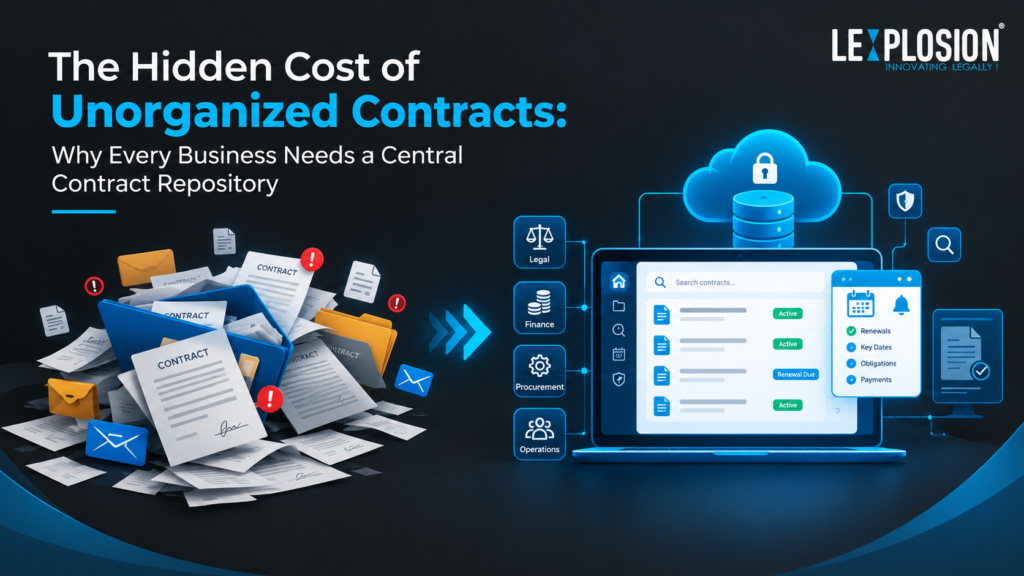
Contracts remain important long after they are signed. Businesses still need to track renewals, deadlines, obligations, payments, and amendments. When agreements are scattered across emails and folders, important details can easily be missed. As contract volumes grow, manual management can waste time, increase costs, and create compliance challenges. Businesses need a simple way to store, search, and monitor agreements after signature.
Why Unorganized Contracts Become a Business Problem?
Signing a contract is only the beginning. The real work continues after the agreement is finalized.
Teams may need to monitor renewal dates, payment terms, obligations, service levels, amendments, and termination clauses. When this information is scattered across emails, shared folders, paper files, and personal drives, important details can easily be missed.
What happens when contracts are scattered?
- Employees spend unnecessary time searching for documents.
- Renewal deadlines can be overlooked.
- Outdated contract versions may be used.
- Important obligations can fall between departments.
- Businesses may continue paying for unwanted services.
- Audits can become more difficult.
As a company grows, these problems become harder to control. More customers, suppliers, partners, and employees naturally mean more contracts to manage.
Without an organized system, finding the latest version of an agreement can become a time-consuming task.
What Is a Centralized Contract Repository?
A centralized repository keeps contracts and related documents in one controlled location. Instead of checking multiple folders or systems, employees can access the information they need from a single source.
Businesses can use contract repository software alongside contract lifecycle management software to manage agreements from creation through renewal. A digital contract repository can also make documents easier to access, organize, and search after signature.
The purpose is not simply to keep files. It is to make contract information useful.
A well-organized repository can show:
| Information | Why It Matters |
| Contract owner | Shows who is responsible |
| Effective date | Confirms when the agreement begins |
| Expiration date | Helps prevent missed deadlines |
| Renewal date | Supports timely action |
| Key obligations | Keeps responsibilities visible |
| Payment terms | Supports financial planning |
| Amendments | Keeps contract history connected |
| Department | Makes ownership easier to identify |
This gives teams a clearer understanding of what each agreement requires and when action may be necessary.
The Hidden Cost of Scattered Contract Data
Unorganized contracts can quietly increase costs through wasted time, missed tasks, and unnecessary administrative work.
1. Lost Time
Employees waste valuable time searching emails, folders, computers, and departments for the right contract document.
2. Missed Renewals
A missed notice period can extend agreements automatically and limit timely renegotiation of pricing or terms.
The result: unnecessary costs and fewer opportunities to improve contractual decisions.
3. Unclear Obligations
Finance, procurement, and operations may share responsibilities that become overlooked when contract information remains difficult to access.
4. Compliance Risks
Missing documents, unclear ownership, and outdated versions make reviews harder and can weaken contract compliance management efforts.
How Centralized Storage Improves Post-Signature Management
The real value of organized contract storage becomes clear after the agreement has been signed.
Instead of treating a contract as a completed document, businesses can continue monitoring its important dates, obligations, and changes.
Teams can search by:
- Contract name
- Customer or supplier
- Department
- Contract owner
- Expiration date
- Contract type
- Keywords
- Status
This eliminates the need to check several folders just to locate one agreement manually.
A centralized contract database can also give legal, finance, procurement, sales, and operations teams better visibility without requiring each department to maintain separate records.
Better Searchability Means Faster Decisions
Find it. Understand it. Act on it.
That simple process becomes difficult when contract information is scattered.
For example, a sales manager may need to confirm a customer’s termination notice period before discussing the next stage of a relationship. Without organized records, they might need to search old emails or ask the legal team to locate the agreement.
With structured contract storage, the relevant information can be found much faster.
Better searchability is especially useful during:
- Contract renewals
- Negotiations
- Audits
- Disputes
- Internal reviews
- Supplier evaluations
- Customer discussions
A digital contract repository can also support remote access while maintaining appropriate controls over who can view or modify sensitive information.
Keeping Track of Renewals and Important Dates
Renewals are among the easiest contract activities to overlook when businesses depend on manual tracking.
Some agreements automatically renew unless notice is provided within a specific period. Others require a pricing review or negotiation before the renewal date.
Important dates worth monitoring include:
Renewal dates → Know when an agreement is due for review.
Notice periods → Understand when action must be taken.
Expiration dates → Avoid unexpected contract endings.
Payment deadlines → Support timely financial processing.
Review dates → Give teams time to evaluate performance.
Milestones → Keep contractual commitments on schedule.
Having these dates visible gives contract owners more time to decide whether an agreement should be renewed, renegotiated, or terminated.
Supporting Better Contract Document Management
Contracts rarely remain the same after signing.
Amendments, addenda, statements of work, and updated versions may be added over time. Keeping these documents connected to the original agreement helps teams understand the complete contract history.
Effective contract document management also makes version control easier.
A good process should answer 3 questions:
– Which document is the original?
– Which changes were made later?
– Which version is currently approved?
When these answers are clear, employees are less likely to rely on outdated terms or incomplete contract information.
Improving Security and Accountability
Contract organization is also about controlling access.
Not every employee needs access to every agreement. Businesses can use role-based permissions to determine who can view, edit, or manage specific documents.
Access controls can help businesses:
- Protect sensitive commercial information
- Limit unnecessary access
- Maintain clearer ownership
- Track document activity
- Support internal accountability
Activity records can also show who accessed or changed information, creating a clearer record of contract activity.
These controls become more important as contract volumes and business operations expand.
Choosing the Right Contract Storage Solution
The right system should solve today’s contract management challenges without creating new ones.
When comparing a contract storage solution, businesses should look beyond basic document storage.
Look for features such as:
| Feature | Business Benefit |
| Search and filters | Find contracts faster |
| Renewal reminders | Reduce missed deadlines |
| Version control | Avoid outdated documents |
| User permissions | Protect sensitive information |
| Audit trails | Improve accountability |
| Integrations | Connect existing business systems |
| Reporting | Improve visibility |
| Scalability | Support future growth |
Ease of use also matters. If employees find the system complicated, they may continue using personal folders, emails, or other unofficial storage methods.
Building a Stronger Contract Management Process
Technology alone cannot solve every contract management problem.
Businesses also need clear responsibilities. Someone should know who owns each contract, who monitors renewals, and which teams need access to specific information.
A stronger process can include:
- Assigning a clear contract owner.
- Using consistent naming conventions.
- Categorizing agreements correctly.
- Connecting amendments with original contracts.
- Setting reminders for important dates.
- Reviewing access permissions regularly.
- Keeping current versions easy to identify.
For larger organizations, enterprise contract management can provide a broader structure for managing agreements across departments, locations, and business units.
The goal is simple: contracts should remain useful throughout their entire lifecycle instead of becoming forgotten files after signature.
Ready to Take Control of Your Contracts?
Contracts remain important after signing, and scattered agreements can cause missed renewals, wasted time, and compliance risks. A central contract repository keeps contracts organized, searchable, and easier to manage throughout their lifecycle. Ready to organize your contracts? Explore how Lexplosion can help manage agreements efficiently from signature to renewal.
Key Takeaways:
- Scattered contracts can waste employee time.
- Missed renewal dates can create unnecessary costs.
- Centralized storage makes agreements easier to find.
- Searchability supports faster business decisions.
- Organized records can improve compliance.
- Version control reduces confusion.
- Clear ownership helps teams manage obligations.
- A structured system becomes more valuable as contract volumes increase.
Frequently Asked Questions:
1. Why is centralized contract storage important?
It gives employees one reliable place to find agreements, review terms, monitor deadlines, and access related documents. This reduces the need to search across emails, folders, and disconnected systems.
2. What should businesses track after a contract is signed?
Businesses should monitor expiration dates, renewal dates, notice periods, payment terms, obligations, amendments, contract owners, and other milestones that require action.
3. Can contract repositories help with compliance?
Yes. Organized contract information makes it easier to identify obligations, maintain accurate records, control access, and prepare documents for reviews or audits.
4. How does contract searchability benefit employees?
Employees can locate agreements faster using information such as contract names, dates, departments, owners, or other indexed details. This reduces time spent searching through unrelated files.
5. When should a business adopt a contract repository?
A business should consider one when contract volume, departments, or compliance requirements make manual storage difficult to manage. Implementing an organized system early can also support future growth.

Lexplosion Solutions
https://lexplosion.in/Lexplosion Solutions Private Limited is a pioneering Indian Legal-Tech company that provides legal risk and compliance management solutions through cloud-based software and expert services.