Contract Lifecycle Management Software: Complete Guide for Legal Teams
Companies handling contracts manually often struggle with are at the center of any business relationship, but when they are handled manually, it’s common to get process delays, compliance gaps, and overlooked obligations. The real cost of poorly managed contracts shows up in the long run as accumulated friction of a process that was never designed to keep up with a dynamic and growing system. Research says that organizations can lose about 9.2% of their yearly revenue to poor contract management habits. practices.
This is where a Contract lifecycle management software becomes critical. It tends to help legal teams smooth out each stage of the contract lifecycle, while also boosting visibility, governance, and overall operations efficiency.
At Lexplosion Solutions, we support organizations in simplifying their contract handling using technology that gives stronger control, better compliance, and more business agility, even when things change fast.
have spent 18 years working at the intersection of law and technology, building products for legal teams. Komtrakt, our CLM platform, is built by lawyers — which means it is designed around how contracts actually work in practice, not just how they look on paper. This guide draws on that experience to help legal teams understand what good contract lifecycle management looks like, and what to look for when selecting a platform.
What is a Contract Lifecycle Management software?
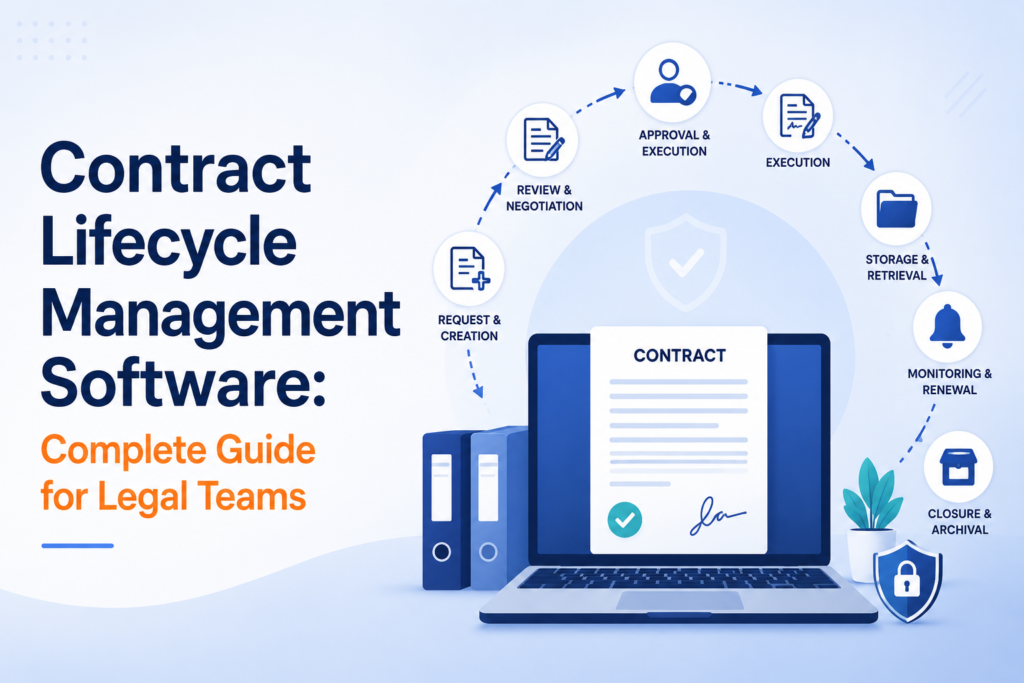
A Contract lifecycle management software is a tool that facilitates the handling of various stages that a contract goes through from the beginning creation of a request to completion execution and recordkeeping. It covers drafting, internal review, approvals, execution, storage, ongoing monitoring, renewal handling, and closure, all in one platform.
A contract lifecycle management tool provides a centralized environment where an organization’s legal teams can manage every stage of the contract lifecycle with greater efficiency and control.
Rather than depending on disconnected systems or doing everything by hand, legal teams can work through more standardized workflows and still keep full visibility into each agreement.
Why Are Traditional Contract Management Ways Are No Longer Enough?
Managing contracts through emails, spreadsheets, and shared folders usually results in approval delays, duplicated documents, process friction and poor visibility. And when the contract amount keeps growing, these manual workflows get harder and more difficult to control and monitor. A CLM platform helps streamline the workflow, gather contract information in one place, and supports the legal team so they can move faster while also reducing operational issues and compliance risks.
What Are the Stages of the Contract Lifecycle?
Contract Request and Creation
So, everyEvery contract begins with a business need. Contract automation software helps simplify the drafting process because it uses approved templates and standardized clauses, improving consistency while reducing repetitive manual work for legal teams. Business teams can request and get access to standard templates while initiating a request at the click of a few buttons.
Contract Review and Negotiation
The legal and business teams will convene to analyze the review the contract, and negotiate the changes required to satisfy the obligations of the contract. A review will be conducted to keep track of the revisions made to the contract to maintain structure before the approval of the final version. and track redlines through to a final agreed version. This stage is where most of the time is lost in a manual process; email chains, version confusion, and no audit trail.
Modern CLM platforms support this stage with integrated document editing, version control, and increasingly AI-assisted review that checks each clause against the organisation’s own playbook and flags deviations, risk levels, and also suggests language edits.
Contract Approval and Execution
Where specific deviations on a contract require approval, the same must be flagged to the relevant authorised approvers before the reviewer can proceed with the draft. A CLM Solution facilitates clause wise approvals to be requested by the legal teams simultaneously on a draft – the tool also keeps a record of all approvals requested, rejected and approved as an audit trail for any future reference.
This ensures that a clear process for approval is followed and a record is maintained to ensure visibility on the go-ahead before proceeding with eth draft.
Once all the negotiations on the contract have been made, the contract will may also be sent to the relevant authorities for an overall approval depending on the organizational requirement and process.
Contract management automation will guide the contracts through the contract management system to aid in the approval and reduce the backlog of contracts.
Execution
Once a contract review is completed and all necessary approvals are obtained, the CLM solutions allow sending the drafts for execution by either downloading and signing offline or e-signing through the tool itself. Once the contract is signed it moves to the contract repository on the tool automatically and saved with all historical records.
Contract Storage and Retrieval
Fully executed contracts must be stored in a secure, centralized location with a tracker recording the basic contract details like party names, effective and expiry dates. Where users want to record additional information upfront CLM solutions facilitate that as well to allow a birds-eye view of key contract data. Contract repository software makes it quick and easy for legal teams to find contracts.
Contract Monitoring and Renewal
Once contracts are executed, they still require oversight. Effective contract tracking software provides insights into obligations and key dates, such as renewals and milestones and also allows initiating termination and amendment requests linked to the main contract.
What Features Should Legal Teams Look for, exactly?
Picking the right contract lifecycle management system is mostly about checking what it can do for legal work and for business momentum.
The right CLM platform should reduce the time your legal team spends on process and increase the time they spend on judgment. That means looking beyond a features checklist and asking: what does each capability actually prevent, or make possible?
Key capabilities include:
Quick first draft using sStandardized templates
Configurable approval workflows
Version control and visibility
Secure document storage
Advanced search
Audit trails
Flexibility to send drafts to third parties form the tool
Renewal reminders
Reporting dashboards
Role-based access controls
With these features in place, the contract management process becomes more organized, consistent, more transparent, and easier for everyone to navigate.
Why does compliance matter throughout the contract life cycle?
Every contract contains obligations that need ongoing monitoring. If you miss key commitments or renewal dates, you can end up facing financial and legal risks.
Contract compliance software supports legal teams with things like tracking contractual obligations, keeping solid audit records, and getting reminders at the right time for critical milestones. It’s a more proactive angle that improves governance, and it also helps organizations stay aligned across the entire contract lifecycle even when things get busy. It also provides greater visibility into compliance status, enabling legal teams to identify potential issues early and take corrective action before they impact business operations.
As a result of these operational advantages more organizations are adopting contract management software in India.
Because as contract volumes keep going up, and compliance rules are getting more nuanced, handling everything manually becomes slow and risky. Contract management software India allows teams to standardize contract workflows, gain clearer visibility across agreements, improve day-to-day collaboration, and manage each agreement in a cleaner, more organized way from start to finish and identify potential issues early and take corrective action before they impact business operations.
Streamline Your Contract Management with Confidence
It is important to understand that effective contract management can’t be done without storing documents in a systematized way. The appropriate contract lifecycle management software helps legal teams gain greater insight, automate processes, manage compliance, and oversee obligations more easily and effectively.
The growth of contract volumes necessitates the use of an integrated solution to mitigate risks and enhance the productivity of the organization. At Lexplosion Solutions, we offer organizations the tools to improve contract lifecycle management through integrated legal technologies to enhance legal operations, governance, and optimize decision-making.
Organisations that manage contracts well do not just avoid problems — they move faster, negotiate better, and carry less accumulated risk in their portfolio. The right CLM platform makes this possible not by replacing legal judgment but by handling the process work that currently consumes it: routing approvals, tracking obligations, flagging renewals, maintaining the audit trail. That frees legal teams to spend their time where it actually matters.
At Lexplosion, we have built Komtrakt on the understanding that CLM is not a one-size-fits-all problem. Every organisation has its own standard positions, its own approval hierarchy, its own mix of contract types. The platform adapts to how you operate.
Key Takeaways
1. Contract lifecycle management software centralizes every stage of contract management.
2. CLM software helps lessen the manual work and improves overall efficiency.
3. Contract automation software makes contract drafting more straightforward by relying on standardized templates.
4. Contract management automation speeds up the approval routes.
5. Contract repository software boosts document findability and governance.
6. Contract compliance software supports ongoing compliance, plus risk management.
7. When organizations use solid contract tracking, they can monitor renewals and contractual obligations more effectively.
FAQs
- What is contract lifecycle management software?
Organizations use contract lifecycle management software to manage each stage of the contract lifecycle through a single platform. This includes the creation, approval, storage, and monitoring of contracts, as well as the renewal and closure of contracts.
- How does CLM software benefit legal teams?
CLM software enhances contract visibility, standardizes and automates contract management workflows, and minimizes the effort needed to manage contracts throughout their lifecycle.
- Why is contract tracking important?
The primary goal of tracking contracts is to help organizations keep tabs on significant milestones and deadlines. Tracking contracts reduces the chances of failing to meet contractual obligations and the deadline for contract renewal.
- What should organizations consider when selecting a contract lifecycle management system?
Organizations should look into workflow automation and security, as well as document management, reporting, scalability, and how easy it feels to use, to make sure the solution really fits both current and future contract management needs.

Lexplosion Solutions
https://lexplosion.in/Lexplosion Solutions Private Limited is a pioneering Indian Legal-Tech company that provides legal risk and compliance management solutions through cloud-based software and expert services.