Govt of India Launches National Logistics Policy, 2022 to improve logistics efficiency
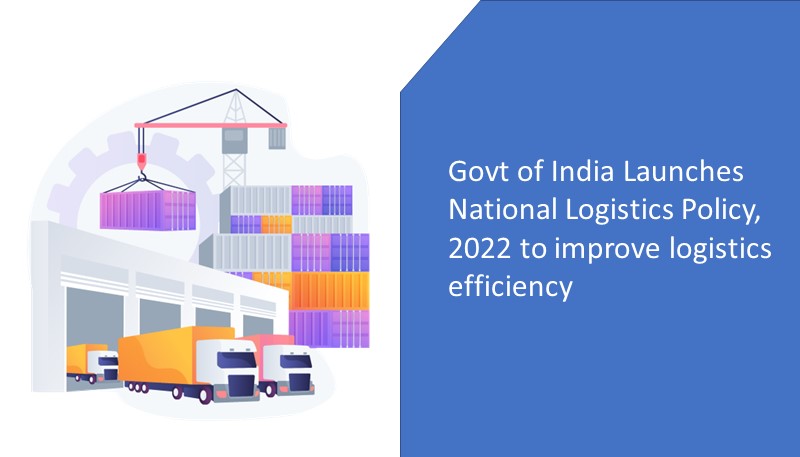
The Prime Minister Shri Narendra Modi has launched the National Logistics Policy, 2022 (“NLP”) for improving logistics efficiency and reducing logistics cost. The NLP will be implemented through a Comprehensive Logistics Action Plan (“CLAP”). The key action areas for the interventions proposed under the CLAP are:
1. Integrated Digital Logistics Systems: To develop a system of unified logistics interface to link multiple data sources and develop cross sectoral use cases for logistics stakeholders.
2. Standardisation of physical assets & benchmarking service quality standards: To enhance interoperability, minimize handling risks, undertake process optimisation, and improve ease of doing business, through standardisation of physical assets and benchmarking of service quality standards in logistics. The E-Handbook on Warehousing Standard (link has been provided in the NLP for downloading the same) envisages to act as an enabling and guiding handbook for facility operators, owners, developers and regulatory agencies to identify and implement facility and sector specific standards.
3. Logistics Human Resources Development and Capacity Building: To develop an overarching logistics human resource strategy and under its guiding principles, line ministries to develop action plans to address skill development related and internal capacity building challenges in the respective sector.
4. State Engagement: To provide support for development of state/city level logistics plans, set up institutional framework to take action at city/state level, measure and monitor action by states and rank them.
5. EXIM (Export-Import) Logistics: Addressing infrastructure and procedural gaps in India’s EXIM connectivity and create efficient and reliable logistics network, with transparent and streamlined cross-border trade facilitation, for improved trade competitiveness and greater integration of India with regional and global value chains.
6. Service Improvement framework: Improving regulatory interface to enable seamlessness between sectors, promote standardisation, formalisation, interoperability; eliminate fragmentation in documentation, formats, processes, and liability regimes; reduce gaps in regulatory architecture.
7. Sectoral Plan for Efficient Logistics: Sectoral Plans for Efficient Logistics (SPEL) would
(i) address logistics issues pertaining to infrastructure, processes, digital improvements, policies and regulatory reforms, and capacity building for better workforce, and
(ii) prioritise cross-sectoral cooperation to complement and not duplicate efforts and focus on optimisation of modal mix.
8. Facilitation of Development of Logistics Parks: Logistics parks (e.g., Multi Modal Logistics Parks, Air Freight Stations, Inland Container Depots, Container Freight Stations, cargo terminals, etc.) are hubs for intermediary activities (storage, handling, value addition, inter-modal transfers, etc.) in the supply chain connected by a transportation network. It is envisaged to take following steps to facilitate development of logistics parks:
a) Draft framework guidelines to facilitate development of Logistics Parks in the country with focus on encouraging private investment.
b) Create a network of logistics parks by mapping them on the PM GatiShakti NMP, for enhanced visibility, improved logistics efficiency, optimum utilisation, and connectivity.
Some initiatives taken by the Government of India in line with the overall objective of NLP:
(i) Logistics Ease Across Different States (“LEADS”) and PM-GatiShakti (“PMGS”) – These initiatives have been taken to improve the logistics efficiency of the country which will improve:
• Domestic and EXIM movement as well as
• India’s ranking in international exercises such as Logistics Performance Index (“LPI”) conducted biennially by the World Bank.
(ii) Unified Logistics Interface Platform (ULIP) – An initiative which has been conceptualised to provide an integrated platform that can be effectively utilized by the stakeholders to enhance efficiency, utilize technology, and reduce the cost of logistics in India. This platform will be utilised by various Govt. and private agencies, service providers, shippers, consignees etc. to enable information exchange on a real/near real time basis amongst all stakeholders in a confidential manner
For a holistic approach to logistics efficiency, the NLP further proposes to establish a Services Improvement Framework for improving regulatory interface to enable promotion of standardization, formalization, and inter-operability and streamlining of fragmentation in documentation, formats, and processes. Such framework is envisaged to be operationalized through:
(i) Formation of a Services Improvement Group (SIG)– SIG will comprise of officers nominated from various user ministries and will provide for the monitoring and coordination mechanism for unresolved user issues pertaining to services, documentation, processes, policy, along with identification of interventions for improving user interface.
(ii) Creation of a Digital Dashboard – E-LogS: Ease of Logistics- A digital system for registering, coordinating, and monitoring resolution of user issues is being developed on which authorized user associations will register and upload their issues/suggestions. This portal has been developed by the Logistics Division, DPIIT to facilitate time-bound resolution of issues.
