India’s Medical Device Regime: Faster Approvals, Stronger Post-Market Surveillance
Introduction
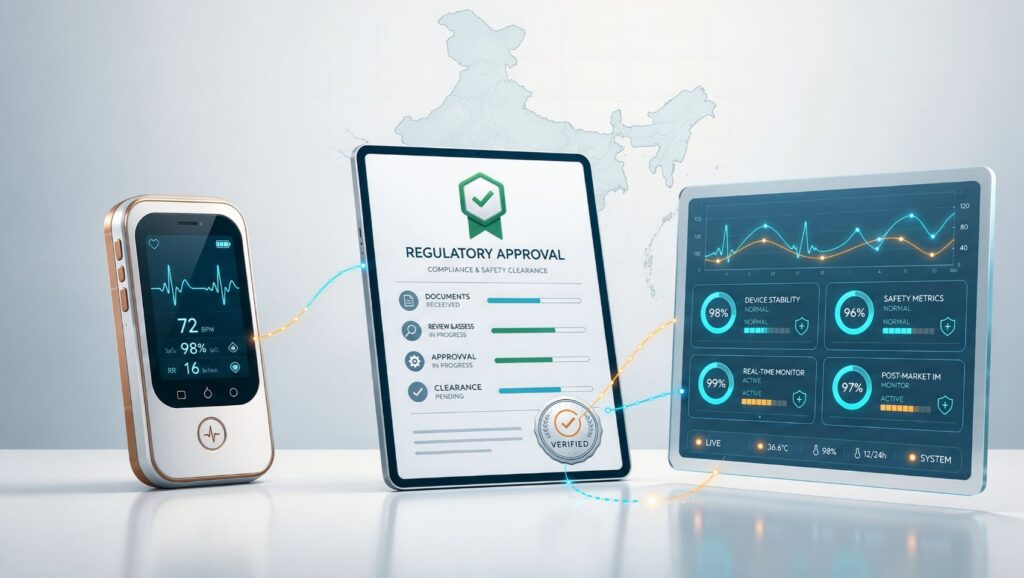
India’s medical device regulatory framework is undergoing a shift towards streamlined market-entry procedures, digital regulatory oversight and stronger post-market enforcement. Recent developments, the licensing reforms, the Medical Device Software guidance and the Drugs Consultative Committee’s recommendation to strengthen enforcement powers and the along with the SUGAM Labs digital enforcement, portal, which CDSCO has now made live, point to a regulatory approach that aims to ease access to the Indian market while strengthening accountability for the safety, quality and performance of medical devices.
This needs to be seen in conjunction with the emerging risk-based classification approach, as well as the revised guidance on the sampling of drugs, cosmetics and medical devices by Drugs Inspectors.
Key regulatory development
- Licensing reforms implemented in June and August 2026 point towards the efforts made in simplifying regulatory processes for medical devices. The licensing reforms for manufacturers and importers make it easier to conduct their business by reducing procedural complexity and improving the efficiency of licensing-related activities.
- The Medical Device Software guidance issued in July 2026 highlights the growing significance of software as a medical device, or as an integral component of a medical device, from a regulatory perspective.
- The Drugs Consultative Committee’s proposal in September 2026 to empower Licensing Authorities to order a stop to manufacture, sale or distribution, and destruction of stock, in cases of contravention of the Act and Rules, is an indication that measures can be taken where devices are found in breach of the Medical Devices Rules, 2017.The amendment, which the DCC has recommended for incorporation into Rule 30(1) of the Medical Devices Rules, 2017, carries significant implications for operations to manufacturers, importers, distributors and other supply chain participants.
- The SUGAM Labs digital enforcement portal is now live, bringing the laboratory network into a single digital workflow with CDSCO’s enforcement and sampling functions. Digitalization facilitates the traceability of samples, the recording of the results of each test, and coordination between the regulatory agencies and testing laboratories.
- Classification based on risk continues to play an important part in the Indian medical device regime in determining the regulatory path as well as the licensing and compliance obligations relevant to a given device. Consequently, manufacturers cannot presume that the regulatory requirements for one device will automatically extend to another device.
Implications for the medical devices industry
- Manufacturers must strengthen quality systems, manufacturing controls and post-market surveillance.
- Importers must ensure that the required licenses and labelling are in place.
- Medical Device Software developers should ensure appropriate classification, software validation and change control.
- Distributors must maintain product traceability and compliance-escalation mechanisms.
- Regulatory and quality teams must coordinate licensing, testing, quality management and regulatory reporting.
Recommended compliance priorities
- Classify all devices, record their license status, and identify the required technical documentation, and quality standards for each device.
- Examine the software validation process cyber security posture and monitor the performance of the device post-deployment.
- Ensure that device handling follows the compliance regulations by developing improved methods of reporting adverse events incidents and product recalls.
- Monitor batches, samples, tests, and distribution documentation and update licenses, testing documentation, and corrective action documentation periodically ahead of inspections.
- Stay on top of regulatory changes and clearly separate what is already in effect from what is still at the proposal stage — for instance, the Rule 30(1) amendment discussed above has been recommended by the DCC but has not yet been notified.
Conclusion
India’s evolving medical device regime shows an effort to make regulatory processes easier while keeping strong checks on product safety, quality and performance. Licensing reforms bring efficiency to the approval process; software guidance, risk‑based classification, the revised sampling methods and the now-live SUGAM Labs digital enforcement system all point to a more organized regulatory watch. The DCC recommendation on Rule 30(1) also warrants close monitoring, since its real impact depends on whether it is formally adopted and notified. For manufacturers, importers and other stakeholders the main priority is to use every simplification, in process but without doing so, at the cost of weaker product‑quality controls or post‑market accountability.
Author: Naisha Mishra
Co-Author: Amiya Mukherjee
This content is intended for informational purposes only and does not constitute a legal opinion. Readers are encouraged to seek legal counsel prior to acting upon any of the information provided herein. Despite our efforts to maintain accuracy, we do not make representations, warranties or undertakings regarding the quality, completeness or reliability of the content. This content, including the design, text, graphics, their selection and arrangement, is Copyright 2026, Lexplosion Solutions Private Limited or its licensors. ALL RIGHTS RESERVED, and all moral rights are asserted and reserved.
For any clarifications, please reach out to us at 91-33-40618083 or inquiries@lexplosion.in. Refer to our privacy policy by clicking here.

Lexplosion Solutions
https://lexplosion.in/Lexplosion Solutions Private Limited is a pioneering Indian Legal-Tech company that provides legal risk and compliance management solutions through cloud-based software and expert services.