RBI rolls out framework for geo-tagging of payment system touch points; expected to enable proper monitoring of availability of payment acceptance infrastructure like Points of Sale (PoS) terminals, Quick Response (QR) codes, etc.
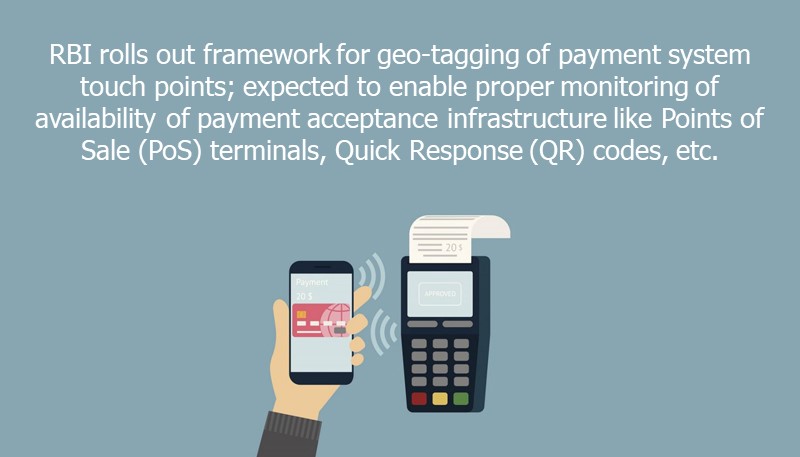
The Reserve Bank of India (“RBI”) has recently rolled out the Framework for Geo-tagging of Payment System Touch Points (“Framework”) to facilitate nuanced spread of acceptance infrastructure and inclusive access to digital payment. The Framework captures the geo-tagging information of payment system touch points deployed by banks / non-bank PSOs.
What is Geo-tagging?
Geo-tagging refers to capturing the geographical coordinates (latitude and longitude) of payment touch points deployed by merchants to receive payments from their customers. Geo-tagging has various benefits, such as, provide insights on regional penetration of digital payments; monitor infrastructure density across different locations; identify scope for deploying additional payment touch points; facilitate focused digital literacy programmes. Policy interventions for realising the above benefits will be facilitated by the information thus collected
Use of geo-tagging to capture the locational data of acceptance infrastructure would be subject to the following guidelines:
a. Banks / Non-bank PSOs shall capture and maintain geographical coordinates for all payment touch points.
b. Geo-tagging information in respect of the following shall be submitted to the Reserve Bank:
• PoS terminals (Mobile PoS, Soft PoS, Tablet PoS, Desktop PoS, Self-service Kiosk PoS, Android-based PoS terminals, Non-Android-based PoS terminals with GPRS SIM Card-embedded, Non-Android-based PoS terminals with PSTN Line Connectivity, etc.); and
• Paper-based / Soft QR Codes (Bharat QR, UPI QR, etc.)
Few of the compliance obligations on the part of Banks and Non-bank PSOs which is expected to potentially emanate from this Framework is as follows:
1. Maintain a registry with accurate location of all payment touch points
2. Report information on payment touch points to the Reserve Bank through the Centralised Information Management System
3. Reporting requirements for banks and non bank PSOs deploying payment touch points
4. Ongoing obligations for all banks / Non-bank PSOs
When are these compliance obligations expected to gain effect?
The date from when the reporting requirements will kick in will be informed in due course.
Key Highlights:
Reporting Requirements-
Information that shall be reported by banks / non-bank PSOs and procedure is detailed below:
1. Information to be submitted to Reserve Bank
All banks / Non-bank PSOs have to maintain a registry with accurate location of all payment touch points across the country, including the information like the following-
a. Merchant-related information – General merchant details (name, merchant ID, merchant type, merchant category, merchant contact details, merchant / payment aggregator information, if any, etc.); Merchant location details (merchant address, state, district, revenue centre, population of revenue centre, post office, pin code, population group, tier, etc.
b. Payment acceptance infrastructure details – General payment touch point details (terminal type, sub-type, terminal ID, date of commencing operations, operating status, etc.) and Payment touch point location details (terminal address, state, district, revenue centre, population of revenue centre, post office, pin code, geo-co-ordinates (latitude, longitude), population group, tier, etc.)
2. Reporting requirements and methodology:
• All banks / Non-bank PSOs shall report information on payment touch points to the Reserve Bank through the Centralised Information Management System (CIMS) of RB
• Reporting of information shall be in .txt / CSV file format.
• Banks / Non-bank PSOs shall report two files-
a. File 1 containing details on the merchants acquired / on-boarded by the banks / non-bank PSOs
b. File 2 containing details on the payment touch points deployed by the acquired / on-boarded merchants
• Banks / Non-bank PSOs deploying payment touch points shall report to RBI:
a. Details of all existing payment touch points deployed (as per timeline indicated by RBI);
b. Details of additional touch points as and when deployed, within seven calendar days from operationalisation / activation of the terminal;
c. Updates and changes pertaining to the existing payment touch points shall be reported within seven calendar days from date of updation / modification
3. Banks / Non-bank PSOs shall be provided with a facility to access / download the data relating to information reported by them.
4. Banks / Non-bank PSOs shall be solely responsible for ensuring data pertaining to payment touch points deployed and the merchants acquired / on-boarded by them is up to date and accurate.
5. Banks / Non-bank PSOs shall put in place necessary measures at their end to ensure timely capture and reporting of required information to the
RBI as per the indicated timelines.
Please refer to the hyperlink below for a detailed read of the Framework.
Source: Reserve Bank of India
