India’s E-Commerce Rules Amended: Key Compliance Changes Effective January 2027
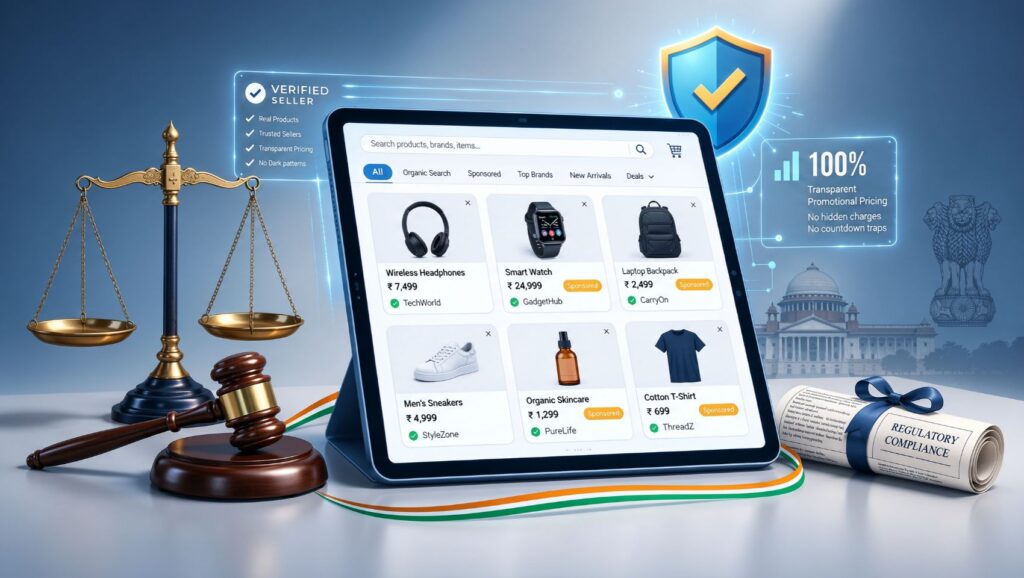
The Consumer Protection (E-Commerce) (Amendment) Rules, 2026, notified on 9 September 2026, will come into force on 1 January 2027. The amendments introduce new requirements relating to search rankings, sponsored listings, promotional pricing, dark patterns and information displayed by e-commerce platforms.
Some obligations apply to all e-commerce entities; others apply specifically to marketplace operators, sellers or inventory e-commerce entities. Businesses should identify the provisions relevant to their operating model and the changes required to their systems and processes.
The key regulatory changes
1. Search rankings and sponsored listings
The definition of “ranking” has been expanded to cover the relative prominence or relevance given to sellers and to goods or services offered through a marketplace, irrespective of the technology used. Marketplace operators must also explain, in plain and intelligible language, the main parameters determining rankings, in descending order of significance, and their relative importance. This explanation must be publicly accessible.
E-commerce entities must not mislead users by manipulating search results or indexes having regard to the user’s search query.
Sponsored listings of products and services must be distinctly identified through clear and prominent disclosures.
2. Promotional pricing and discounts
Where an e-commerce entity or seller announces a price reduction on its platform, the reduced price must be shown alongside the prior price. The Rules define “prior price” as the lowest price of the goods or services in the 30 days preceding the announcement. Businesses running frequent promotions should review how those prices are recorded and displayed.
3. Dark patterns: annual self-audit and certification
Every e-commerce entity must comply with the Guidelines for Prevention and Regulation of Dark Patterns, 2023. The amendment also requires an annual self-audit to ensure that its platform is free from dark patterns, with a certificate to that effect prominently displayed.
4. Additional restrictions for marketplace operators
Marketplace e-commerce entities must not use information collected by them (a) for the sale of goods, directly or indirectly by any seller, bearing a brand or name common with the marketplace, or (b) to promote or advertise a seller as associated with the marketplace, unless express and affirmative consent has been obtained from the consumers concerned for such use. The restriction concerns these specified uses of information, not all processing of consumer data.
Marketplace e-commerce entities must not collect bundled fees from users for services unrelated to the e-commerce platform. Loyalty and membership programmes, and the benefits, services, offers and incentives provided under them, are expressly exempt.
5. Seller, product and invoice information
Marketplace operators must display seller information, including the seller’s business name, geographical address and customer care number, as well as website details, email address and ratings or aggregated feedback, where available. Upon a consumer’s written request after a purchase, the operator must also provide the seller’s contact information needed for effective dispute resolution.
Marketplace listings must include information on returns, refunds, exchanges, warranties, delivery, payment and best-before or use-before dates. For food products, the date-disclosure requirement is subject to the Food Safety and Standards Act, 2006 and the regulations made under it. Related product-information provisions also apply to sellers and inventory e-commerce entities.
Sellers offering goods or services through a marketplace must provide any identification number issued by the Central Government, including a Goods and Services Tax Identification Number (GSTIN) or Micro, Small and Medium Enterprises (MSME) registration number, for the marketplace’s display requirements.
Every e-commerce entity must also display the seller’s name prominently on invoices in the same font size as the e-commerce entity’s name. For imported goods or services, the applicable disclosures include importer details and, for goods imported into India, the full country-of-origin name in accordance with the Legal Metrology (Packaged Commodities) Rules, 2011.
6. Grievance handling and National Consumer Helpline participation
The existing requirement for grievance officers to acknowledge complaints within 48 hours and resolve them within one month continues. The amendment additionally requires complainants to be given a copy of the complaint as recorded by the grievance officer. Every e-commerce entity must also become a partner in the Central Government’s National Consumer Helpline convergence process, which was earlier a best-efforts requirement.
7. General platform disclosures
Every e-commerce entity must clearly and prominently display its legal name, the principal geographical addresses of its headquarters and branches, website details, and the email addresses, landline and mobile numbers of customer care and the grievance officer at an appropriate place on the platform.
What should e-commerce businesses do before 1 January 2027?
With the amendments coming into effect on 1 January 2027, e-commerce businesses should identify which provisions apply to their operating model and which require changes to technology or day-to-day processes.
For marketplace operators, priorities include reviewing ranking disclosures, sponsored listings, seller information and the restrictions on use of collected information. Businesses advertising discounts should check historical price records and promotional displays. Annual dark-pattern self-audits will also need to become part of their compliance processes.
Other workstreams include invoice templates, imported-product disclosures, complaint handling, National Consumer Helpline participation and platform contact details. Businesses should allocate responsibility for each applicable requirement and review implementation progress before the effective date.
Sources:
PIB Release: Government amends E-Commerce Rules to strengthen consumer protection and promote transparency: https://www.pib.gov.in/PressReleaseDetail.aspx?PRID=2308759®=48&lang=1 Consumer Protection (E-Commerce) (Amendment) Rules, 2026: https://consumeraffairs.gov.in/public/upload/admin/cmsfiles/whatsnews/E_Commerce_Amendment_Rules_2026_2026-09-11_18-12-39.pdf
Author: Anupriyo Guha
Co-Author: Amiya Mukherjee
This content is intended for informational purposes only and does not constitute a legal opinion. Readers are encouraged to seek legal counsel prior to acting upon any of the information provided herein. Despite our efforts to maintain accuracy, we do not make representations, warranties or undertakings regarding the quality, completeness or reliability of the content. This content, including the design, text, graphics, their selection and arrangement, is Copyright 2026, Lexplosion Solutions Private Limited or its licensors. ALL RIGHTS RESERVED, and all moral rights are asserted and reserved.
For any clarifications, please reach out to us at 91-33-40618083 or inquiries@lexplosion.in. Refer to our privacy policy by clicking here.

Lexplosion Solutions
https://lexplosion.in/Lexplosion Solutions Private Limited is a pioneering Indian Legal-Tech company that provides legal risk and compliance management solutions through cloud-based software and expert services.