ESIC notifies Employees’ State Insurance (General) Regulations, introduces revised registration, contribution, claims and benefit administration requirements
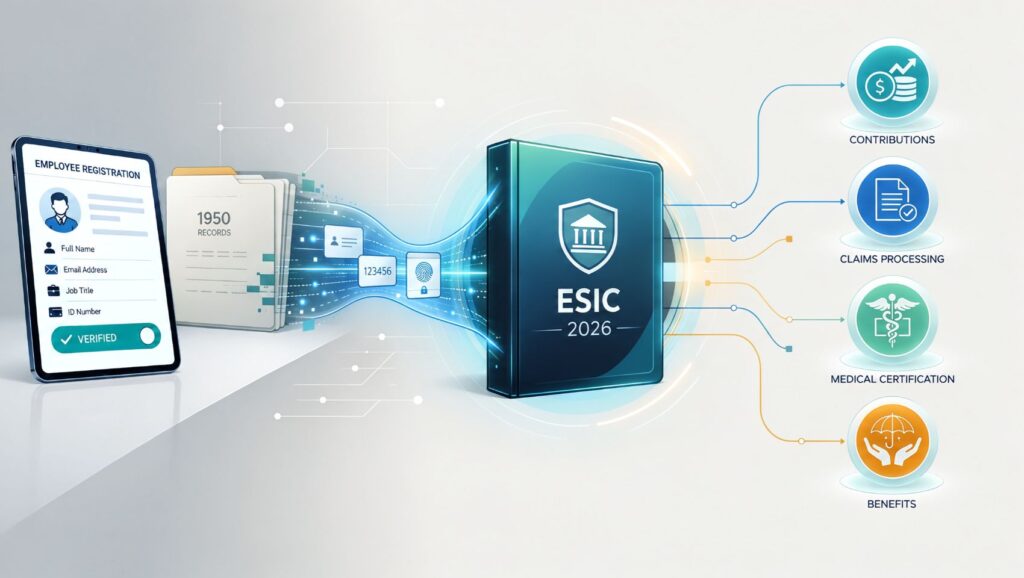
The Employees’ State Insurance Corporation (“ESIC”) has notified the Employees’ State Insurance (General) Regulations, 2026 (“Regulations”) under the Code on Social Security, 2020 (“Code”), superseding the Employees’ State Insurance (General) Regulations, 1950, except in respect of acts done or omitted before such supersession. The Regulations prescribe the framework for registration of employees, maintenance and updating of employee and family particulars, contribution payments, filing of returns, claims for benefits, medical certification and administration of ESIC benefits.
Key Highlights:
- Employers are required to obtain the prescribed declaration and particulars, including photographs and family details, from employees for registration on the specified portal. Declaration forms are required to be preserved during the employee’s period of employment, preferably in electronic form.
- Employees are required to intimate changes in family particulars, and employers are required to ensure that such changes are updated in the employee’s registration details on the specified portal. Employers are also required to preserve such intimations during the employee’s employment.
- Employers are required to file monthly contribution returns in the prescribed Form 2 on the specified portal, covering employees engaged directly or through contractors for whom contributions are payable, within 15 days from the end of the month. Returns for a contribution period are required to be filed within 45 days of its termination, while returns in case of permanent closure are required to be filed within 15 days of closure.
- Contributions are required to be paid electronically through an authorised bank within 15 days from the last day of the calendar month in which the contributions fall due.
- Claims for benefits are required to be submitted in the prescribed forms or through an accepted electronic mode, along with the relevant medical certificates and supporting documents. The Regulations also provide for assistance to insured persons who are unable to submit claims themselves.
- The Regulations introduce provisions for deemed claims for specified sickness and maternity benefits, subject to prescribed conditions, including issuance of medical certificates through ESIC’s information system. Eligible benefits may be paid through Direct Benefit Transfer to the insured person’s or beneficiary’s bank account.
- The Regulations prescribe timelines for payment of benefits after complete claims and supporting documents are submitted, including 7 days for Sickness Benefit, 15 days for Funeral Expenses, 14 days for the first payment of Maternity Benefit, 1 month for the first payment of Temporary Disablement Benefit and Permanent Disablement Benefit, and 3 months for the first payment of Dependants’ Benefit.
- The Regulations prescribe requirements for submission of medical certificates, supporting documents and evidence for claims. Defective claims may be returned for correction, with provisions allowing resubmission within the prescribed period.
- The Regulations prescribe requirements for availing medical benefits, including production of the Insured Person Card or other prescribed identification. Reimbursement of medical treatment expenses may be permitted in specified circumstances and subject to prescribed conditions and rates.
- Employers are required to provide information and particulars relating to an insured employee’s absence from work where sickness or temporary disablement benefits are claimed or paid, and to extend necessary assistance to the Corporation in relation to employee registration and updating of particulars.
- Where an employee receives leave pay under the terms of employment and also receives sickness, maternity or temporary disablement benefits for the same period, the employer may make an adjustment after the benefit has actually been received. Such adjustment is required to be supported by a written calculation provided to the employee, and any subsequent reduction or disallowance of the benefit requires reversal of the corresponding adjustment.
Source: E Gazette

Lexplosion Solutions
https://lexplosion.in/Lexplosion Solutions Private Limited is a pioneering Indian Legal-Tech company that provides legal risk and compliance management solutions through cloud-based software and expert services.